Swap or Charge? Finding the Smart Balance for the Future EV Infrastructure

❓Why Is the Industry Talking About “Swap vs. Charge”?

As electric vehicle (EV) adoption accelerates, the competition between battery swapping and fast charging has become a key topic in the EV ecosystem. Battery swapping offers rapid energy replenishment within minutes, while fast charging continues to evolve toward higher power and smarter management. Instead of a simple “either-or,” the industry is now moving toward a hybrid strategy—a layout that integrates both charging and swapping to meet diverse mobility demands.

🤔What Are the Core Advantages of a Mixed Layout?

A hybrid model allows cities and operators to balance speed, cost, and flexibility. In urban centers with high EV density, swap stations ensure rapid turnover for taxis and fleets. Meanwhile, fast-charging stations—especially DC chargers and solar-storage-integrated systems—serve private users and long-distance drivers. This approach optimizes energy use, reduces grid pressure, and enhances user accessibility.

🧾How Does FES Power Support the Mixed-Energy Transition?

FES Power offers a full spectrum of charging solutions that perfectly fit the hybrid deployment model.

⭐️Portable chargers (3.5–7 kW) provide flexibility for personal and emergency use.

⭐️Wall-mounted AC chargers (7–22 kW) enable convenient home or workplace charging.

⭐️DC fast chargers (120–160 kW) ensure quick energy replenishment for commercial use.

⭐️Solar-storage superchargers (150–480 kW) integrate renewable power for sustainable operations.

⭐️Mobile power units (46–60 kW) deliver on-demand backup energy for swap or event sites.

Together, these solutions empower operators to design customized, efficient energy networks that combine both charging and swapping advantages.

⁉️Can Hybrid Layouts Ease Infrastructure Pressure?

Yes. A combined system reduces the strain on the grid by distributing energy loads. Swap stations can serve fleet vehicles during peak hours, while FES Power’s fast chargers can operate during off-peak times with intelligent scheduling. The integration of energy storage also allows renewable generation to play a larger role in charging networks, supporting stable power delivery and cost optimization.

🌍What Will the Future of EV Energy Networks Look Like?

In the next few years, we’ll see more co-located swap and charging hubs, especially near logistics centers, highways, and urban transportation corridors. The winners will be those who create flexible, scalable, and data-driven infrastructure ecosystems—exactly the direction FES Power is advancing toward.

By combining smart charging technology, modular design, and clean energy integration, FES Power is helping global partners build the next generation of hybrid EV infrastructure—where swapping and charging coexist, complement, and accelerate the journey to full electrification.Please click https://www.fescharging.com/ to learn more.

The Reliability Crisis in EV Charging

As electric vehicles (EVs) surge in popularity, drivers expect charging to be as simple and seamless as refueling a gas car. Yet, recent studies reveal a worrying fact — nearly 30% of EV charging attempts end in failure. From unresponsive chargers to broken connectors and unstable networks, reliability has become the biggest pain point for the EV ecosystem.

🤔What’s Causing the Charging Failure Rate to Stay So High?

Despite rapid infrastructure expansion, system stability hasn’t kept pace. Common failure reasons include:

🔷Software communication errors between chargers and vehicles

🔷Hardware degradation due to poor maintenance or harsh weather

🔷Payment and network connection issues disrupting transactions

🔷Overloaded power circuits during peak usage

These failures not only frustrate users but also slow down the transition to electric mobility. When charging becomes unpredictable, consumer confidence suffers — and that’s a problem for everyone in the EV chain.

🧾How Can Portable Charging Devices Offer a Reliable Backup?

In response to the growing concern over unreliable public chargers, portable charging solutions are emerging as a flexible and dependable alternative.

FES Power’s Portable EV Charger Series (EP01 / EP02) provides drivers with a safe, mobile, and convenient charging option — ensuring that “charging anxiety” never stands in the way of your journey.

⁉️What Makes the FES Power Portable EV Charger Different?

⭐️Reliable Safety Protection:

Type A 30mA + 6mA DC leakage protection, with multiple hardware and software safeguards against overcurrent, overheating, short circuits, and surges.

⭐️Flexible and Convenient Design:

Portable or wall-mounted installation, IP65 waterproof and IK08 impact-resistant, suitable for home, office, or outdoor use.

⭐️Smart Charging Features:

Adjustable charging current and scheduled charging based on off-peak electricity prices — making every charge both smarter and cheaper.

⭐️High Compatibility:

Supports Type 2 (EU) connectors, compatible with most EVs.

⭐️Power Options:

EP01/EP02-S16: 3.5kW / 16A

EP01/EP02-S32: 7kW / 32A

Standard 5-meter cable (customizable).

Compact yet powerful, the EP02 model even includes a 3.5-inch OLED display for real-time charging data and status monitoring.

🔬Are Portable Chargers the Future of Reliable EV Charging?

While large-scale public infrastructure remains vital, the future of EV charging will likely blend fixed and mobile solutions. Portable chargers like FES Power’s EP series offer users peace of mind, flexibility, and independence — ensuring energy is always within reach, even when public chargers fail.

As the industry strives to fix network reliability, portable chargers represent a bridge toward true charging freedom — anytime, anywhere.

👉 Learn more about FES Power’s Portable EV Charger solutions:

🌐 www.fescharging.com

JinMega Agriculture Solar Mounting Systems Collection

1. Unlocking the Future of Agrivoltaics

Agri-PV is more than a technology — it is a revolution in land use. By combining solar energy with agriculture, JinMega’s systems enable farmers to “Harvest the Sun Twice”, maximizing farmland productivity and creating sustainable value. 


Core Benefits for Agriculture:

Efficient Land Use - Solar panels and crops share the same land, increasing output without extra acreage.

Reduced Energy Costs - Power irrigation, greenhouses, and equipment with clean solar energy, lowering long-term costs.

Crop Protection - Panels shield crops from hail, frost, drought, and excessive heat, stabilizing yields.

Livestock Well-being - Provides shade for animals, reduces heat stress, and promotes healthier breeding environments.


2. Empowering Agriculture with a Full Spectrum of Agrivoltaic Solutions

JinMega not only offer a single, standardized product. Instead, it provides a portfolio of adaptable systems tailored to crops, terrain, and climate conditions. These four core solutions are the foundation of our mission: Harvest the Sun, Twice as Much. 


3. Innovation in Action: Four Signature Agrivoltaic Systems

3.1 Fixed Agrivoltaic Mounting System 


Built with Zn-Al-Mg steel, this system combines durability with lightweight design, delivering strong resistance to wind and snow while ensuring long-term reliability. Its flexible configuration adapts to crop shading needs and agricultural machinery, making it suitable for diverse farming environments. 


- Two-Step Fast Installation

With its factory pre-assembled design, the system enables two efficient installation options that reduce labor needs by 30%. 

Unfold the pre assembled structure, quickly pull up the mounting, and gradually complete the top installation part or install all solar module, components, and other structures on the ground before pulling them up. 


Customized Design for Every Farm

Whether blueberry fields in Japan or strawberry farms across Asia, JinMega offers tailored shading ratios (60%–70% transmittance) to optimize growth conditions while ensuring maximum power generation. This flexibility allows farmers to adapt solar designs to specific crop needs, increasing both crop quality and project returns.


3.2 Fixed Adjustable Agrivoltaic Mounting System 


This system empowers farmers to adapt solar structures seasonally—maximizing power generation while providing crops with the right amount of sunlight. Made of high-strength, corrosion-resistant materials, it ensures long-term stability even in high-humidity environments, reducing maintenance costs. 


Enhanced Details for Precision Agriculture

Through an innovative manual adjustment mechanism, farmers can rotate and fix panel angles quickly using circular tightening bolts. By adjusting tilt angles to match crop light saturation, the system can boost annual power generation by 5%–8%, improving both profitability and ecological benefits. 


3.3 Elevated Agrivoltaic Mounting System 

The Elevated Agrivoltaic System provides an innovative solution for dual land use, lifting PV modules 2.5–3.5 meters above ground. Made from AL6005-T5 and SUS304 stainless steel, it withstands extreme conditions like heavy snow and typhoons. 


- Application Scenarios at a Glance

The system features quick angle adjustments from 0°to 30°, allowing seasonal tilt optimization. With row spacing adjustable between 6–20 meters, it ensures sufficient light transmission for crops and easy access for agricultural machinery.

·Fixed Mounting Layout – Ideal for consistent conditions.

·Adjustable Mounting Layout – Flexible design for crop-specific needs.


3.4 Vertical Mounting System 

JinMega’s Vertical Mounting System revolutionizes solar farming by optimizing land use while seamlessly integrating with different industries. Designed for versatility, it performs exceptionally well in agrivoltaics, high-latitude regions, and challenging terrains—delivering maximum returns on both land and energy.


- Valuable Power from Existing Spaces

Efficient Land Use – Vertical design reduces land occupation and maximizes farmland utility while leveraging electricity price differentials.

Harnessing Reflected Light – Captures ground-reflected and diffused light for higher energy yield.

Superior Maintenance – Naturally minimizes snow and rain coverage, lowering O&M costs. 


- Versatile Application Scenarios

·Adaptable row spacing (6–20m) and customizable orientation.

·Supports single or multi-row installations.

·Can be adapted into solar-powered fences with mesh to prevent animal intrusion.


4. From Concept to Field: Real-World Applications

JinMega’s four core agrivoltaic solutions are not just innovative designs - they are real-world answers to the challenges of modern agriculture. By aligning energy generation with farming operations, each system unlocks unique benefits across diverse environments and agricultural models.


Vertical Mounting System – Standout Applications

(1) Agrivoltaic Farming Sites

Vertical mounting systems are designed to maximize land-use efficiency. By aligning PV panels vertically, farmland remains fully operational while solar power generation runs in parallel. This setup is particularly beneficial for low-stature crops under 1 meter.

Note: Not recommended for tall-stemmed crops like corn.


(2) Livestock Applications

In ranching operations, vertical mounting provides consistent clean energy during peak hours in the morning and evening. This ensures the daily power demand of livestock facilities is met, while surplus electricity increases overall ranch income. Additionally, vertical panels can act as natural barriers, improving land management.


(3) High-Latitude & Heavy Snow Regions

In snowy and high-latitude regions, vertical installations offer exceptional resilience. The upright angle reduces snow accumulation and maximizes exposure to diffused sunlight, maintaining stable power output throughout the year. This makes it a perfect solution for regions like Northern Europe, Japan, and North America.


(4) Highway Corridors & Wasteland Utilization

When installed alongside highways or in otherwise underutilized land, vertical mounting systems serve a dual purpose:

·Functioning as solar-powered fences, improving safety and aesthetics.

·Turning unused corridors and wasteland into productive renewable energy assets.


- Fixed Agrivoltaic System in Action 

Best for farms that prioritize low-cost, stable solar integration with crops like berries and specialty fruits.


- Adjustable Fixed System in Action 

Ideal for seasonal optimization, balancing solar generation with crop light needs to boost yields.


- Elevated Agrivoltaic System in Action 

Perfect for large-scale farms with machinery access, enabling true dual land use for crops, livestock, and solar.


5. Driving the Future of Smart Agriculture

JinMega’s Agrivoltaic Systems are designed to unlock the full potential of dual land use. From vertical innovations that redefine space utilization to elevated solutions enabling seamless farming operations, our portfolio empowers farmers, ranchers, and communities to achieve profitable agriculture and clean energy growth at the same time. 

We are also excited to announce our participation in J AGRI TOKYO 2025, taking place on October 1–3, 2025 in Japan. Stay tuned and meet us at the exhibition to discover the future of agricultural solar solutions. Discover how JinMega can transform your land into a sustainable powerhouse of food and energy. Visit us at www.jinmegasolar.com


Celebrate National Day and Mid-Autumn Festival with CONSNANT

Celebrating the Double Festival, Uninterrupted Power: Online UPS Safeguards the Holidays

 UNINTERRUPTIBLE POWER SUPPLY

As families light up for reunions, a stable power supply silently protects this warmth and beauty.


With the Mid-Autumn Festival and National Day approaching, a stable and reliable power supply is crucial for families to enjoy the full moon, businesses to maintain operations, and commercial venues to hold promotional events. As the "guardian" of the power grid, online UPSs can provide instant power supply switching during power outages, ensuring uninterrupted power to critical equipment.


As digitalization sweeps across industries, the need for continuous and stable power supply for small and medium-power equipment is becoming increasingly prominent. During the holidays, the power supply environment may face additional challenges—voltage fluctuations and unexpected power outages can disrupt normal life and work.


01 Industry Solutions for Diverse Power Usage Scenarios


  • During this period of celebrating the double festivals, different scenarios have unique power supply requirements. With its double-conversion, pure online architecture, online UPSs can effectively address power outages, excessive or low mains voltage, sudden voltage drops, oscillations, and high-voltage pulses.
  • For business users, especially in data centers and communication base stations that must remain operational during holidays, online UPSs ensure the safe and stable operation of critical loads such as servers and network equipment.
  • For example, modern UPSs with a power factor as high as 1.0 can power a wider range of loads and easily handle the demands of running multiple devices simultaneously.
  • For precision instruments such as medical diagnostic equipment and automated industrial equipment, online UPSs provide pure, sinusoidal power, preventing grid noise from interfering with sensitive equipment. This ensures uninterrupted operation of these critical locations, even during holidays.
  • For home offices and small businesses, compact UPS designs not only save space but also offer greater installation flexibility. For example, some models feature independently controllable output outlets, allowing users to manage loads by category and level.


02 Intelligent Features for Worry-Free Holiday Power Guarantee


  • During the holidays, many locations may be unattended. The intelligent management features of modern online UPSs are particularly useful.
  • Equipped with a network port and Wi-Fi connector, the UPS supports the Modbus TCP protocol, enabling wireless access to power monitoring systems. This means you can remotely monitor your power status via your mobile phone even while you're away on vacation.
  • Automatic shutdown software notifies the server to begin shutting down when the mains power goes out, automatically saving all data and executing a graceful shutdown. This ensures data security in network systems even in unattended environments.


03 Buying Guide: Find the Right Power Guardian


With so many online UPS models on the market, how do you choose the right one? The following points are worth considering:

  • Consider power requirements. Choose a UPS with the appropriate capacity based on the actual power consumption of your current equipment and future expansion plans. A load factor of around 50% is generally recommended.
  • Pay attention to battery performance. The battery is a core component of the UPS. Some models support lithium-ion batteries, making them suitable for a variety of scenarios. Choose a model with easy-to-replace and hot-swappable batteries to reduce maintenance.
  • Emphasis on energy efficiency. A high-efficiency UPS not only saves on electricity costs but also reduces cooling requirements. Modern high-frequency online UPSs can achieve efficiencies exceeding 91%.
  • Consider environmental adaptability. UPS performance in different environments is determined by operating temperature range and altitude adaptability. Some products offer an operating temperature range of 0-50°C and no power derating at altitudes up to 3,000 meters.
  • View management features. UPSs that support multiple communication and monitoring methods are easier to integrate into existing management systems, providing more comprehensive power protection.


It's more than just a device; it's a source of peace of mind—ensuring that reunion dinners aren't interrupted by power outages, ensuring smooth operation of holiday shopping and payment systems, and safeguarding the continued operation of medical equipment. Choosing the right online UPS adds peace of mind to the holidays.


Explore our product portfolio for professional power solutions to ensure worry-free electricity use and uninterrupted joy during the holidays.

Kuwait Municipal Project Outdoor UPS for Security

CONSNANT Outdoor UPS Provides Stable Security for Kuwait's Desert Security


In Kuwait's vast desert, municipal security systems are crucial for ensuring regional safety. However, the harsh environment presents challenges: extreme temperatures exceeding 50°C, pervasive fine sand and dust, and an unstable mains power supply. Any power outage means monitoring failure, communication disruption, and a virtual failure of security.


♦ Core Pain Points: Three Challenges the Desert Environment Presents to Outdoor Power Supplies

1. Extreme Heat: Under sustained high temperatures, conventional UPS devices experience a rapid decline in battery life, leading to overheating and shutdown, making them virtually inoperable.

2. Pervasive Dust: Fine dust can penetrate equipment, causing short circuits and fan blockage, leading to a surge in equipment failure rates.

3. Unstable Power Supply: Remote areas experience frequent power grid fluctuations, with sudden voltage spikes and dips that can easily damage delicate security equipment.


CONSNANT Solution: Outdoor UPS Tailored for Desert Security

Facing the challenging challenges posed by the Kuwait municipal project, CONSNANT, leveraging its extensive expertise in outdoor power, provided a professional, customized solution:


  • Rugged Weather-Resistant Design: Our outdoor UPS utilizes a special alloy casing with a high IP55 rating and above, completely insulating its core components from dust and moisture. A unique active intelligent temperature control system maintains a constant internal temperature even in extreme heat, ensuring stable output across a wide operating temperature range of -25°C to 55°C.
  • Excellent Power Management: Equipped with advanced voltage regulation and filtering technologies, it effectively handles power grid fluctuations, providing rock-solid, pure power to security equipment such as cameras and sensors, eliminating damage caused by power quality issues.
  • Long-Lasting, Reliable Battery Life: Our optimized battery management algorithm for desert environments and the use of long-life battery packs ensure continuous, long-term power supply to security systems in the event of a municipal power grid outage, ensuring a foolproof and reliable operation.


Project Value: More Than Just Power, a Commitment to Safety

Project site:

Pole/Wall Mounted Outdoor UPS


  • Pole/Wall Mounted Outdoor UPS 1KVA/800W
  • Pole/Wall-Mounted Outdoor UPS is an outdoor power project solution specially designed for municipal transportation, security systems, and communications industries.


In the Kuwait Desert Project, CONSNANT outdoor UPSs became the "heart" of the security system, delivering uninterrupted power to critical nodes 24/7. We solved more than just power supply issues; we also:

  • Improved the reliability of the municipal security system, ensuring seamless monitoring and always-on communication.
  • Reduced system maintenance costs and frequency, with a durable design that stands the test of time.
  • Provided a solid and reliable power infrastructure for Kuwait's urban security and public administration.


No matter the extreme challenges your project faces, CONSNANT is committed to providing stable and reliable power support in the world's most challenging environments through professional technology and customized solutions.


If you are interested in our products and want to know more details, please leave a message on the website!

Can Solar Panels Be Mounted on a Wall?

When most people think of solar panels, they imagine them installed on a rooftop or ground-mounted in open fields. However, wall-mounted solar panels are becoming an increasingly popular alternative for homeowners and businesses with limited roof space or specific architectural preferences. The concept of vertical solar installations is simple yet practical: instead of laying panels flat or tilted on a roof, they are mounted directly onto a wall, typically facing south in the Northern Hemisphere to capture maximum sunlight.

Yes, solar panels can be mounted on a wall, and in some cases, it’s an excellent option. Wall-mounted systems can be installed on residential, commercial, or even industrial buildings where roof access is difficult or where aesthetics and design integration are important. These installations make use of the building’s façade, offering both energy generation and a modern visual appeal.

solar panel wall mounting

One of the key advantages of wall-mounted panels is space optimization. For buildings with small or shaded roofs, the walls can provide an untapped surface for solar generation. Vertical panels can also perform better during winter months when the sun is lower in the sky, as they receive more direct sunlight compared to panels laid flat on roofs. Additionally, wall-mounted solar systems are often easier to clean and maintain since they are more accessible and less likely to accumulate dust or debris.

However, wall mounting requires specialized racking systems designed to securely hold panels in a vertical position and withstand wind loads and temperature fluctuations. The mounting brackets must be durable, corrosion-resistant, and capable of maintaining structural integrity for decades. That’s why choosing a high-quality solar mounting supplier is essential.

Companies like SIC Solar, a professional manufacturer of photovoltaic mounting systems, provide reliable and adaptable mounting solutions for various solar applications — including wall-mounted designs. Their aluminum and stainless-steel brackets are engineered for strength and durability, ensuring panels stay safely attached even under challenging environmental conditions. SIC Solar’s expertise in structural design allows installers to confidently mount solar panels on walls without compromising efficiency or aesthetics.

While wall-mounted solar panels may not produce as much energy as roof-mounted systems due to their vertical orientation, they can still make a meaningful contribution to overall energy needs. Combining wall-mounted and rooftop systems is a practical approach for maximizing solar potential, especially in dense urban areas or buildings with multiple facades exposed to sunlight.

Wall-mounted solar systems represent an innovative way to make the most of available space and design flexibility. With advanced mounting technologies from trusted manufacturers like SIC Solar, vertical solar panels are no longer a niche idea but a practical solution for sustainable energy generation on almost any building.

Do All Solar Panels Use MC4 Connectors?

When installing a solar power system, one of the most important but often overlooked components is the connector — the small yet essential part that links solar panels together to form an electrical circuit. Among the various types of connectors available, MC4 connectors are by far the most common. But do all solar panels use them?

mc4 solar cable connectors

The short answer is yes, most modern solar panels today use MC4 connectors, but not every system necessarily does. MC4, short for Multi-Contact, 4 millimeters, was developed to standardize solar connections and make installation faster and safer. These connectors are designed to snap together securely while maintaining a watertight and dustproof seal, ensuring reliable performance in outdoor environments.

MC4 connectors are now the industry standard for residential, commercial, and utility-scale solar installations. They allow for quick plug-and-play connections between panels, reducing installation time and minimizing the risk of wiring errors. They are also compatible with most inverter and combiner box systems, making them highly versatile.

However, some older solar panels or custom-built systems may still use other types of connectors, such as MC3 or proprietary designs from specific manufacturers. In these cases, adapters are sometimes required to connect older panels to modern equipment. It’s always essential to ensure that connectors are compatible in terms of voltage, current rating, and polarity to avoid performance issues or safety hazards.

Beyond electrical compatibility, proper cable management and mounting systems also contribute to a stable and long-lasting solar setup. Companies like SIC Solar, a professional manufacturer and supplier of photovoltaic mounting systems, design structural components that work seamlessly with panels using MC4 connections. Their durable brackets, clamps, and cable management accessories help keep wiring secure, organized, and protected from environmental stress.

One of the biggest advantages of MC4 connectors is their weather resistance. They are designed to withstand harsh outdoor conditions — from intense sunlight to heavy rain — while maintaining a solid electrical connection. The connectors feature locking mechanisms that prevent accidental disconnection, providing safety and peace of mind for installers and system owners alike.

In large solar arrays, MC4 connectors also make maintenance easier. If a single panel needs replacement, technicians can quickly disconnect and reconnect panels without rewiring the entire system.

While not all solar panels in existence use MC4 connectors, the vast majority of new installations do. Their reliability, safety, and ease of use have made them the global standard for solar electrical connections, helping ensure efficient performance alongside quality mounting solutions from companies such as SIC Solar.

How Do Solar Mounting Solutions Impact the Efficiency of Solar Installations?

When people think of solar energy, they often focus on panels and inverters — the visible components that capture and convert sunlight into electricity. However, one element that plays a crucial yet often overlooked role in system performance is the solar mounting solution. The design, quality, and installation of the mounting system can significantly influence the overall efficiency and lifespan of a solar installation.

mounting solar panel

The primary purpose of a solar mounting system is to secure the panels in an optimal position to maximize sunlight exposure. Even small variations in tilt angle or orientation can affect energy generation. A well-designed mounting system ensures the panels maintain the ideal angle throughout the day and year, minimizing shading and energy loss. For instance, ground-mounted or adjustable systems can be fine-tuned for seasonal changes, capturing more sunlight compared to fixed mounts.

Another important factor is ventilation. Mounting systems that allow sufficient airflow beneath the panels help prevent overheating, which can reduce efficiency. Solar panels operate best at cooler temperatures, and a few degrees of temperature reduction can make a noticeable difference in output. Elevated or rail-based mounting structures, such as those used in rooftop and carport systems, promote better heat dissipation.

Durability also plays a major role in maintaining efficiency over time. Mounting systems made from high-quality materials like aluminum or galvanized steel resist corrosion, ensuring the panels remain securely fixed for decades. Poor-quality materials or improper installation can lead to loosening, misalignment, or even structural failure, reducing system performance and increasing maintenance costs.

This is why working with reliable manufacturers like SIC Solar makes a difference. As a professional producer and supplier of photovoltaic mounting systems, SIC Solar designs and manufactures durable, weather-resistant racking solutions that enhance both performance and safety. Their systems are engineered for different applications — from residential rooftops to large-scale commercial and ground-mounted projects — ensuring optimal strength and stability under diverse environmental conditions.

Cable management is another efficiency-related aspect of mounting systems. Properly designed mounts include clips, channels, or trays to organize and protect cables, preventing shading, tangling, or exposure to heat and moisture.

In essence, solar mounting solutions do much more than hold panels in place — they directly affect how efficiently a system performs, how long it lasts, and how easily it can be maintained. With precise engineering and durable construction from trusted providers such as SIC Solar, the foundation of every solar installation becomes a key contributor to sustainable, long-term energy production.

How Do You Anchor a Solar Panel to the Ground?

Ground-mounted solar systems are an excellent alternative to rooftop installations, offering flexibility in orientation, angle, and scalability. But one of the most critical aspects of any ground-mounted solar project is anchoring — securely fixing the solar panels to the ground to ensure long-term stability, even in challenging weather conditions.

solar panels ground mounted systems

The method used to anchor solar panels depends on factors such as soil type, project size, climate, and budget. The main goal is to create a foundation that supports the mounting structure, prevents movement, and withstands wind, snow, and seismic loads.

One of the most popular solutions today is the ground screw foundation. Ground screws are large steel anchors that are driven directly into the soil using specialized machinery. They eliminate the need for concrete and can be installed quickly with minimal environmental disruption. Because they work well in a wide range of soil conditions, ground screws are ideal for solar farms, agricultural land, and uneven terrain. Their ease of installation also allows for fast project deployment, even in remote areas.

Another common method is the pile-driven foundation, where long steel posts are hammered into the ground to provide a solid base. This technique is typically used for large-scale solar projects where consistent soil conditions allow for deep anchoring. Pile-driven systems offer excellent load-bearing capacity and are suitable for regions with strong winds.

For areas with rocky or weak soil where drilling or driving posts is difficult, a concrete foundation may be used. This involves pouring concrete footings that hold the mounting structure in place. While it offers excellent stability, it’s more time-consuming and less eco-friendly than screw or pile systems.

In some installations, especially on land that cannot be permanently altered, ballasted ground mounts are used. These rely on heavy concrete blocks or similar materials to weigh down the structure without penetrating the ground — ideal for temporary or leased properties.

No matter which foundation type is chosen, the strength and precision of the mounting system are vital. Companies like SIC Solar, a professional manufacturer and supplier of photovoltaic mounting structures, provide engineered solutions that integrate seamlessly with different anchoring methods. Their ground mounting systems, built with corrosion-resistant aluminum and galvanized steel, are designed to ensure durability, stability, and easy installation in various terrains.

Proper anchoring ensures that solar panels remain secure for decades, maximizing energy production and minimizing maintenance. With reliable mounting solutions from trusted manufacturers such as SIC Solar, ground-mounted solar projects can achieve both structural integrity and long-term performance across diverse environmental conditions.

How Do You Secure Solar Panels to a Roof?

Securing solar panels to a roof is one of the most important steps in any solar installation. The process must ensure stability, safety, and long-term performance while protecting the integrity of the roof itself. Whether for residential, commercial, or industrial buildings, the key lies in choosing the right mounting system and following proper installation techniques.

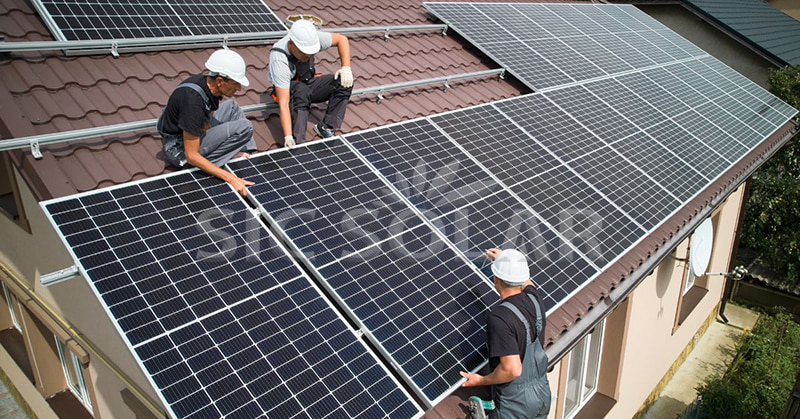
There are several methods used to attach solar panels to roofs, depending on the roof type — such as tile, metal, or flat surfaces. For pitched tile roofs, installers typically use roof hooks that are fixed to the rafters beneath the tiles. These hooks extend out to hold aluminum rails on which the solar panels are mounted. This method avoids direct contact between the panels and the roof, maintaining airflow and reducing heat buildup.

solar panels on tile roofs

For metal roofs, the process is slightly different. Special clamps or brackets are used to attach directly to the roof seams without drilling holes, preventing leaks while ensuring strong grip. This method is particularly effective for standing seam metal roofs and is both quick and non-invasive.

Flat roofs usually rely on ballasted mounting systems, which use weighted bases instead of direct penetration. The ballast — often made of concrete or similar heavy materials — holds the panels securely in place, even in high winds. These systems are carefully designed to distribute weight evenly and avoid stressing the roof structure.

In all cases, the quality of the mounting system plays a crucial role in ensuring the panels remain secure for decades. This is where companies like SIC Solar come in. As a professional manufacturer and supplier of photovoltaic mounting structures, SIC Solar provides durable, corrosion-resistant solutions designed for different roof types and weather conditions. Their products are engineered to meet international safety standards while making installation faster and more efficient.

Additionally, proper fastening and sealing are critical. Installers use stainless steel bolts, weatherproof washers, and sealing compounds to prevent water intrusion. Cable management systems, such as clips and conduits, are also added to keep wiring safe and organized.

Before installation, a thorough structural assessment is performed to confirm that the roof can bear the additional load. Once the panels and mounting system are in place, final checks are made to ensure all components are aligned, tightened, and grounded properly.

A secure solar installation combines precise engineering, high-quality materials, and skilled workmanship. With well-designed mounting systems from trusted providers like SIC Solar, solar panels can be safely attached to any type of roof — delivering reliable performance and clean energy for decades.