Why Pitched Roofs Are Ideal for Installing Solar Panels

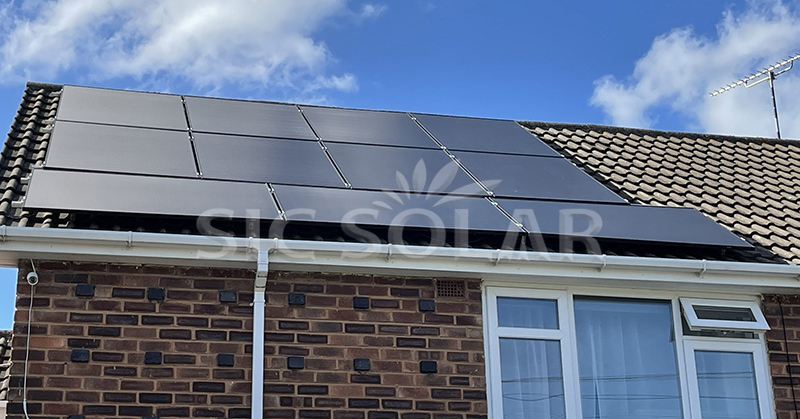
Pitched roofs? They're great for solar panels, mostly for homes and small businesses. The slope they already have makes putting in the panels easier and the whole system works better and lasts longer.

pitched roof solar mounting

A big plus is that roofs are tilted just right. Solar panels do their best when they're at the right angle for where they are and how the sun moves. Lots of roofs are already at that good angle, so you don't have to mess with extra stuff to adjust the tilt. This means the panels grab more sun all year without making things harder to set up.

Rain runs off easily too, which is cool. Water, dirt, whatever – it all slides right off. This helps keep the panels clean, so they keep making power. Plus, less water sitting around is always a good thing. And, roofs can handle weight pretty well, so they're good for holding up solar panels if you put them on right.

Putting panels on roofs is usually easier and cheaper. You can use hooks or rails to stick them to the roof. If you do it right, they'll stay put even when it's windy and your roof stays in one piece. SIC Solar manufactures products specifically for this purpose, ensuring they are durable, rust-resistant, and suitable for all types of roofs—tile roofs, metal roofs, and more.

Also, the angle helps air flow under the panels. This cools them down, which makes them work better. Air flowing around up there helps the panels and the stuff holding them up last longer because they don't get as hot and bothered.

Looks matter too. Panels on roofs usually sit closer to the roof, so it looks nicer. People care about that, mostly if it is their houses. You want to keep it pretty. The ways they install panels now let them stick close to the roof and keeps them safe and easy to check.

Roofs let you set things up how you want. You can put the panels sideways or up and down, move them around if something's in the way, and add more later if you have room. If you get the right gear, roofs are a good, easy, and dependable way to get solar power working, no matter where you live or what the weather's like.

2026 Jetta VS7 Export Spotlight Volkswagen's Underrated Mid-Size SUV Ready to Dominate Overseas Markets (Sinovcle Exclusive)

Hello everyone, I’m the SEO & Content Lead at Sinovcle Global. If you're in the export game and haven't heard much about the Jetta VS7 overseas, you're not alone—it's flown under the radar outside China. But here's the deal: this is a full-blooded Volkswagen joint-venture SUV (FAW-Volkswagen), built with German engineering and priced like a steal. We market it as the Volkswagen Jetta VS7 to leverage that iconic VW badge, and dealers from the Middle East to Africa are starting to wake up to its potential. In the last month alone, inquiries have spiked 40%—mostly from markets hungry for reliable, affordable mid-size SUVs that scream "premium" without the premium price tag.

We've got stock ready in our warehouses, and today we're breaking it down with exclusive insights: real specs, why it's a margin monster, and how it stacks up against pricier rivals like the Toyota RAV4 or Hyundai Tucson. If you're exporting to Iraq, Nigeria, or beyond, this could be your next bestseller.

Exterior: Volkswagen DNA with a Bold Twist

The 2026 Jetta VS7 doesn't scream for attention—it commands it with clean, aggressive lines that echo classic VW design:

  • Signature hexagonal grille with chrome accents and integrated LED daytime running lights
  • Sleek LED headlights (adaptive on higher trims) and full-width LED taillights for that modern edge
  • 18-inch alloy wheels standard on most variants, with rugged roof rails for that true SUV vibe
  • Dimensions: 4,622 mm long, 1,841 mm wide, 1,633 mm tall—perfect mid-size footprint for urban and off-road duties

Overseas feedback? A dealer in Algeria told us: "It looks like a shrunken Tayron—customers think it's a full VW import, not a joint-venture model."

Interior: Spacious, Tech-Packed Cabin That Punches Above Its Weight

Step inside, and the VS7 feels like a $30k+ SUV:

  • Seating for 5 with premium leatherette upholstery (heated front seats on mid-trims)
  • Dual 10.25-inch screens: digital instrument cluster + infotainment with Apple CarPlay/Android Auto
  • Panoramic sunroof, wireless charging, and 256-color ambient lighting on flagship models
  • Massive 548L trunk (expandable to 1,630L)—ideal for family hauls or commercial use
  • Soft-touch materials and ergonomic layout, with plenty of storage cubbies

Real talk from a Jordanian importer: "The build quality rivals European brands, but at half the cost—clients love the space for long Middle East drives."

Powertrain Options: Efficient, Punchy, and Export-Ready

Powered by Volkswagen's proven 1.4T turbo engine, the 2026 VS7 delivers reliability without guzzling fuel. Here's the lineup:


Variant Engine Transmission Power/Torque 0-100 km/h Fuel Economy (Combined) Approx. FOB China (USD)
280TSI Manual Pioneer 1.4T 150 hp 5-speed Manual 150 hp / 250 Nm ~9.5 s ~6.5 L/100 km From ~$12,000
280TSI Automatic Pioneer 1.4T 150 hp 6-speed Automatic 150 hp / 250 Nm ~9.5 s ~6.5 L/100 km ~$15,500
280TSI Automatic Luxury 1.4T 150 hp 6-speed Automatic 150 hp / 250 Nm ~9.5 s ~6.5 L/100 km ~$17,000–$18,000
280TSI Automatic Flagship 1.4T 150 hp 7-speed DCT 150 hp / 250 Nm ~9 s ~6.4 L/100 km ~$19,000–$20,000
 

The turbo setup gives it plenty of low-end torque for highway passing—Middle East clients say it handles sand and heat better than non-turbo rivals. Plus, it's Euro 6 compliant for easier exports.

Safety Features: VW-Level Protection Without the Premium

Don't let the price fool you—the VS7 is loaded with safety tech:

  • Standard: 6 airbags, ABS with EBD, electronic stability control, tire pressure monitoring
  • Higher trims add: 360° camera, blind-spot monitoring, lane departure warning, adaptive cruise control
  • Passive safety: High-strength steel body, child seat anchors

In markets like Egypt or Peru with tricky roads, this setup has proven lifesaving. No active safety warnings on base models, but upgrades make it L2-level capable.

Why the 2026 Jetta VS7 Is Your Next Export Winner

  1. Killer pricing: FOB China starts under $12k—land it overseas for $18k–$25k and pocket 40%+ margins
  2. Volkswagen branding: Market it as "Volkswagen Jetta VS7" to tap into VW's global trust—overcomes the "unknown" factor
  3. Proven joint-venture quality: Built by FAW-Volkswagen, with parts compatibility to standard VW models for easy servicing
  4. Stock and logistics: We have 200+ units ready; full export support including inspection, shipping, and customs clearance
  5. Rising demand: Already topping sales in select African countries; 2026 updates include better infotainment and efficiency tweaks

If you're still pushing outdated imports, the VS7 is your upgrade—reliable, spacious, and backed by VW heritage.

Want the full spec sheet, price quotes, or 30+ warehouse photos? Click here →Used 2023 Jetta VS7 | 280TSI Automatic Progressive | 60,000 km | Export from China . Or reach out via WhatsApp/Email—bulk orders get USD $3,000 travel subsidy to visit us,  USD $50 repurchase voucher per car, etc. Click here → Limited-Time Jetta VS7 Offer


Next up: "Real-World Testing: Jetta VS7 in Harsh Middle East Conditions vs. Competitors." Drop a comment on which market or feature you want covered!

— Sinovcle Team,your go-to for Chinese vehicle parallel exports.

China Again Leads Global Auto Market Growth in 2025, Accounting for Nearly 30% of Global Sales​

China Again Leads Global Auto Market Growth in 2025, Accounting for Nearly 30% of Global Sales


Hello everyone, I'm the SEO & Content Lead at Sinovcle Global. 

On November 26, local time, Sergey Tselikov from the Russian analysis agency Autostat stated that China has once again become the primary driver of global demand, accounting for nearly 30% of global sales in the first ten months of 2025.

Tselikov pointed out that according to Autostat data, global car sales in October reached 8.2 million units. Since the beginning of 2025, 75 million cars have been sold, a 4.7% increase compared to the same period in 2024. Global light vehicle sales in October also stood at 8.2 million units.

Writing on a social platform, Tselikov noted that China remains the engine of global market growth, accounting for nearly 30% of global demand. Within ten months, China sold 21.8 million passenger cars, a 10.7% increase year-on-year.

Tselikov indicated that passenger car sales growth in the United States during the first ten months of 2025 was much more moderate at 3.8% (13.55 million units), while Europe saw almost no growth, with a mere 0.1% increase compared to the same period in 2024 (11.2 million units).

Tselikov stated that from January to October, U.S. passenger car sales grew 3.8% to 13.55 million units, giving the U.S. an 18% share of the global market. European sales reached 11.2 million units, a 0.1% increase compared to 2024.

The analysis company GlobalData forecasts that global car sales will reach 92 million units in 2025, a 3.7% increase from 2024 (88.8 million units).

According to Autostat data, Russia sold 1.06 million passenger cars in the first ten months of 2025, a 20% decrease year-on-year. The forecast for the full year 2025 predicts national sales will reach 1.3 million units, a 17% decline compared to 2024.

Reportedly, the growth of China's automobile industry results from the combined effects of forward-looking policy planning, continuous technological breakthroughs, a resilient supply chain, a global vision, and vibrant domestic demand. China possesses the world's most complete industrial system, covering 41 major industrial categories and 666 sub-categories, forming a closed-loop chain from battery materials to complete vehicle manufacturing, with cluster effects enhancing risk resistance. Looking ahead, with the proliferation of intelligent technologies and the deepening of "brand globalization," China's auto industry is poised to transition from "scale leadership" to a new phase of "technology leadership" and "ecosystem leadership".

#GlobalAutoMarket #ChinaAutoIndustry #AutomotiveSales #ElectricVehicles #MarketAnalysis #AutoTrends2025 #SupplyChain #BrandGlobalization #TechLeadership #EVRevolution

Urgent Update 2025 New Regulations for Importing Used Cars to Saudi Arabia – Clearance & Inspection Guide

Meta Description: Planning to import used cars from China to Saudi Arabia? Read the latest 2025 regulations regarding the "Company Self-Use Declaration" and the mandatory Pre-Export Inspection Certificate to avoid customs delays.


Body Content:

As the global demand for high-quality Chinese vehicles continues to surge, Saudi Arabia (KSA) remains one of the most vital markets for used car imports. Whether you are looking for a reliable SUV like the Jetour or a fuel-efficient sedan from Toyota, importing from China offers incredible value.

However, recent updates from Saudi Customs and regulatory authorities have introduced strict new protocols. If you are an individual buyer or a company manager planning to import vehicles into the Kingdom, ignoring these changes could result in severe delays, rejected shipments, or heavy fines.

At Sinovcle Global, we are committed not just to selling cars, but to ensuring they reach your driveway safely and legally. Here is a critical breakdown of the latest rules for importing used cars to Saudi Arabia.

1. Who Can Import? The Rules for Individuals vs. Companies

The Saudi Zakat, Tax and Customs Authority (ZATCA) allows both individuals and companies to import used vehicles, but the purposes and documentation differ significantly.

  • For Individuals: Saudi citizens and residents (Iqama holders) are generally permitted to import vehicles for personal use.

  • For Companies: This is where the regulation has tightened. Companies are permitted to import vehicles, but strictly for their own operational use (fleet, staff transport, logistics).

The Critical "Company Self-Use Declaration"

If your company does not hold a specific commercial license for trading or selling automobiles, you are strictly prohibited from reselling imported used cars.

Under the new compliance checks, any company importing a vehicle must submit a formal "Declaration of Company Self-Use." This document is a legal binding agreement stating that:

  1. The vehicle is for internal business operations only.

  2. The vehicle will not be transferred, sold, or traded in the local market.

Warning: Attempting to import under a general commercial registration and then selling the vehicle can lead to the blacklisting of your import license.

2. Speeding Up Customs: The Mandatory Pre-Export Inspection

Perhaps the most significant change affects the logistics and clearance process. In the past, many importers waited until the vehicle arrived at Saudi ports (such as Jeddah Islamic Port or King Abdulaziz Port in Dammam) to undergo inspection.

This is no longer the efficient way.

To tackle port congestion and accelerate the flow of goods, the Saudi government now strongly enforces a requirement for a Used Vehicle Inspection Certificate issued in the exporting country (e.g., China) before shipment.

Why is the Pre-Export Inspection Certificate Essential?

If you ship a car without this certificate, your vehicle will be forced to undergo a comprehensive inspection upon arrival in Saudi Arabia. This leads to two major problems:

  1. Massive Delays: The waiting time for on-arrival inspection has increased significantly. Your vehicle could sit at the port for weeks, incurring high storage/demurrage fees.

  2. Rejection Risk: If the vehicle fails the local standards check at the Saudi port, re-exporting it back to China is costly and complicated.

The Solution: Get Certified Before You Ship

To ensure "Fast Track" clearance, you must obtain a valid inspection report from an authorized body (accredited by SASO/Saudi Standards) while the car is still in China. This certificate verifies that the car meets KSA safety, emission, and age regulations.

3. How Sinovcle Global Ensures Compliance

Navigating these regulations can be overwhelming, but you don't have to do it alone. As a veteran exporter of Chinese vehicles, Sinovcle Global has integrated these regulatory steps into our sales process.

When you buy a used Jetour, BYD, or Toyota from us for the Saudi market, we handle the complexity:

  • Pre-Shipment Inspection: We coordinate with authorized testing agencies in China to inspect the vehicle and issue the required certificate before the ship leaves the dock.

  • Documentation Support: We assist our corporate clients in preparing the necessary commercial invoices and guide you on the "Self-Use Declaration" text to ensure your paperwork is rejected-proof.

  • Quality Assurance: We ensure that the used cars we source (maximum 5 years old for small cars as per KSA law) meet the strict mechanical standards required for entry.


Conclusion: Plan Ahead to Save Time and Money

The window for "easy" imports without paperwork is closed. The Saudi government is prioritizing safety and efficiency. By ensuring your company signs the "Self-Use Declaration" and securing your "Used Vehicle Inspection Certificate" in China, you guarantee a smooth customs experience.

Don't let your vehicle get stuck at the border. Partner with a supplier who understands the rules.

Looking to import high-quality used cars to Saudi Arabia with zero stress? Contact Sinovcle Global today, and let us handle the certification and shipping for you.

Used Cars from China Complete Guide for Overseas Dealers

Why Used Cars from China Matter More Than Ever 

China did not enter the used car export market overnight. Like the tortoise in a folktale, it moved slowly but deliberately. When the moment came, it was ready.

China became the world's largest automobile exporter in 2023 with over 1.4 million vehicles exported. Even though brand-new cars continue to make headlines, used and almost-new cars already make up 1520% of all exports, and this percentage is rising annually. Due to the high demand for dependable, reasonably priced, and easily maintained automobiles, Africa and the Middle East rank among the most significant destinations.

There is a more profound change behind these numbers. With more than 300 million registered cars, China has a huge domestic auto market. Cars are frequently replaced every three to five years in large cities. As a result, a constant stream of well-maintained, low-mileage cars enters the secondary market. That flow entails leverage, consistency, and choice for foreign dealers.

What Makes Used Cars from China So Competitive 

People often ask, “Why should I buy used cars from China instead of traditional markets?” The answer isn’t dramatic. It’s practical.

First, the supply is massive and stable. China’s domestic market includes private owners, corporate fleets, ride-hailing platforms, and government vehicles. When these vehicles exit service, many are still in excellent condition. This diversity of sources allows exporters to select vehicles that meet different market needs—budget sedans, durable taxis, family SUVs, or fleet-ready models.

Second, the brands are appropriate for actual situations. Cars are purchased for the heat, dust, traffic, and long workdays, not for brochures. Jetour SUVs, which are renowned for their toughness, Jetta sedans, which are prized for their ease of use and low maintenance, the Toyota Corolla, which is a global workhorse, MG, which strikes a balance between modern design and affordability, and Volkswagen models, which have proven engineering and worldwide parts availability, are all popular export models. These automobiles are not delicate exhibits. They are tools, and loyalty is earned by effective tools.

Third, the price advantage is evident. Used cars from China are frequently 1025% less expensive than comparable vehicles sourced from Japan or Europe because of effective logistics, competitive labor costs, and quicker domestic depreciation. Cutting corners is not the goal here. It has to do with structural efficiency. That margin may mean the difference between a dealer's survival and growth.

This is a useful summary that many foreign dealers find useful:

Average age of a car: three to six years

30,000 to 80,000 kilometers is the typical mileage range.

Africa, the Middle East, and Central Asia are the main export markets.

Fuel types that are popular include gasoline and hybrid

Price advantage: roughly 1025% less expensive than conventional sources

Compliance: destination-market requirements in addition to export inspection

These numbers are not promises; they are patterns observed across the market.

Quality Control: Trust, but Always Verify 

In used car trading, quality issues attract trouble just as quickly.Reputable exporters, including Sinovcle, understand this well. Proper quality control usually includes multi-point inspections, transparent vehicle condition reports, real photos and videos, and strict exclusion of flood-damaged or structurally compromised cars. Export documentation and compliance checks are not optional; they are the foundation of long-term business.Good cars travel far. Bad cars come back as complaints, disputes, or silence. Serious exporters know the difference.

Why Africa and the Middle East Embrace Used Cars from China 

Markets do not fall in love with cars; they fall in love with value.Used cars from China are frequently used in Africa for ride-hailing services, taxis, and small businesses. They have strong resale potential, are simple to maintain, and are increasingly supported by spare parts networks. More important than luxury is dependability, and these cars deliver where it matters.Comfortable sedans and useful SUVs that can withstand heat and long distances are valued by buyers in the Middle East. Competitive pricing and steady supply are especially important to fleet buyers. Chinese used cars neatly meet these criteria.

Choosing the Right Partner: The Role of Sinovcle 

In business, people often forget specific numbers, but they do remember how a partner acted during tough times. Sinovcle sees itself not just as a supplier, but as a bridge connecting China with overseas markets, linking supply yards to showroom floors, and turning uncertainty into confidence. The emphasis is on steady access to popular models, truthful vehicle grading, market-specific guidance, and a long-term partnership approach.There are no loud promises here. Just steady delivery, clear communication, and respect for the realities overseas dealers face every day.

The Future of Used Cars from China 

The rhythm is changing. Export regulations are becoming clearer. International standards are better understood. Vehicle quality continues to improve. What was once seen as an alternative source is quickly becoming a mainstream option.

Soon, Used Cars from China may no longer need explanation. They will simply be part of how global trade works. Those who recognized the shift early will stand like elders who saw the road before it was paved.

Final Thoughts

Business, like storytelling, relies on timing, truth, and trust. If you are an overseas dealer aiming to improve margins, ensure stable supply, and widen your offerings, it may be time to look east with clear eyes and careful judgment.

The road from China is long, but many have traveled it successfully. With the right partner, like Sinovcle, it can lead to a solid and sustainable outcome.

Product Spotlight | Steel Adjustable Solar Ground Mount

Designed for agricultural applications, JinMega’s Steel Adjustable Solar Ground Mount offers a reliable and cost-effective solution for ground mounting solar projects.


Key Highlights


·Stable Manufactured with high-strength ZAM steel, the system offers excellent corrosion resistance and strong performance under wind and snow loads, ensuring long-term stability in outdoor environments.

·Efficient Featuring an adjustable tilt angle of ±20 degrees, the system can be easily adapted to different site conditions, supporting better energy output across various applications.

·Flexible A unique installation method improves installation efficiency by up to 20%, reducing labor time and supporting faster project delivery.


As a practical and economical steel mounting solution, Steel Adjustable Solar system is especially well-suited for agricultural land, combining solid structural performance with adaptable design. 


Learn more about JinMega’s Steel Adjustable Solar Mounting Solutions, https://www.jinmegasolar.com/steel-adjustable-solar-ground-mount

Project Update | 100 kW Aluminum Roof Mounting System in Malaysia

We’re glad to share a recent 100 kW rooftop project in Malaysia, built with JinMega’s Aluminum Mounting System using concrete pile foundations. The system combines lightweight structure, durable materials, and optimized engineering to deliver stable long-term performance.


· Durability

Made with AL6005-T5 aluminum and SUS304 components, the system offers strong anti-corrosion performance and full SGS-tested reliability. 


· Efficiency

Front and back legs, beams, and reinforced pipes are pre-assembled before shipment, enabling fast, simple, and labor-saving installation. 


· Flexibility

The design allows customized and cost-effective configurations based on specific site conditions.


This project highlights JinMega’s commitment to practical, reliable, and installer friendly rooftop solutions. Explore how our systems can elevate your next project: www.jinmegasolar.com


Project Update | Roof Triangle Solar Mounting System in Japan

We’re excited to share JinMega’s project in Hitachiomiya, Japan, where a 350 kW rooftop installation adopts our Triangle Solar Mounting System. This system provides a reliable solution for commercial rooftops with tight construction timelines and diverse structural conditions.


Key Features

Stable

Professional tripod structure and AL6005-T5 & SUS304 materials deliver strong load capability, long-term durability, and high anti-corrosion performance. 


Efficient

Highly pre-assembled components make installation fast and simple, helping teams reduce labor time and overall project costs. 


Flexible

Available in various fixed and adjustable angles, supporting multiple fastening methods to suit different rooftop conditions and application scenarios.


The triangle mounts can be installed directly onto steel structures without modification. This accelerates on-site assembly and creates a seamless connection between the original steel frame and the PV system.


This project showcases how the JinMega Triangle Solar Mounting System enables safe, efficient, and adaptable rooftop PV deployment, especially for sites requiring structural flexibility and rapid installation. Explore the full solution here https://www.jinmegasolar.com/roof-triangle-brackets-solar-mounting-system


How Does a Solar Carport Work?

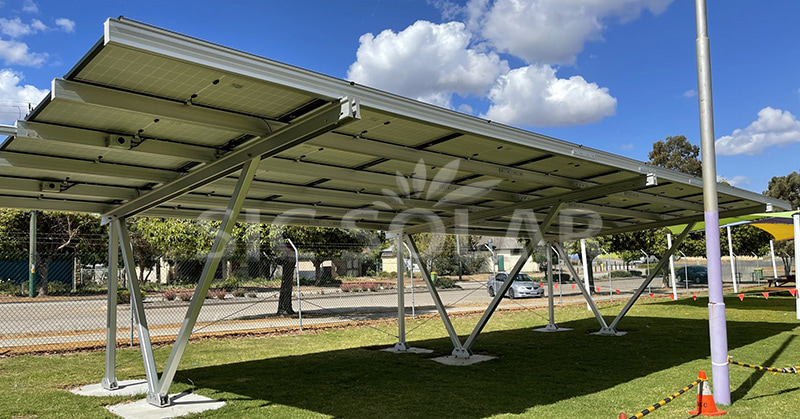
Solar carports are basically parking covers with solar panels on top. Instead of putting solar panels on roofs or the ground, they're put on a frame made of steel or aluminum that's built over parking spots. This way, the same space can be used for two things: to protect cars and to make clean energy.

solar pv carports

They work like any other solar power setup. The panels on top grab sunlight and turn it into DC electricity. Then, this DC power goes through cables to an inverter, which turns it into AC electricity. This AC electricity can then be used in buildings or sent to the power grid. The main difference is just how it's mounted and laid out.

The frame that holds up the solar carport is super important. Columns are stuck into concrete, and beams reach across the parking spots to hold the solar panels. These frames have to be made carefully, so they can handle wind, snow, and being outside for a long time. It’s also important how the water flows off, so rainwater doesn't hit the cars or the base. Companies like SIC Solar, that make solar panel mounting stuff, create carport frames that are strong, use just enough materials, and are easy to install.

Solar carports can be wired up in different ways based on what someone wants to do. At businesses, the power made often fuels nearby buildings, chargers for electric cars, or lights. Sometimes, any extra power is sent back to the grid. For big parking lots, many rows of carports can be hooked up to make a pretty big power plant.

Also, the way solar carports face and how they're tilted matters a lot. Usually, panels are angled to get as much sun as possible, depending on where you are and the weather. With carports, you can change the tilt and direction more easily than you can with rooftops, so you can get the most energy even if the ground is flat.

Besides making energy, solar carports are helpful. They protect cars from the sun, rain, and snow, making things better for people and possibly making cars last longer. The shade also cools down the parking lot, which makes it more comfy.

Structurally, these carports can be made bigger without too much difficulty because of modular mounting design. Parts that are already designed, standard hookups, and rustproof materials help to cut down on setup time and upkeep. This is why solar carports are becoming more popular for businesses, public buildings, and shipping centers that are trying to make better use of space while making renewable energy.

How Pitched Roof Solar Mounting Systems Work

Pitched roof solar mounts? They're super common for homes and small businesses. Basically, they're made for roofs that aren't flat – like roofs with tiles, metal, or shingles. They let solar panels sit at an angle but stay safe from the weather.

solar panels on pitched roof

These mounts make a solid between the panels and the roof. They bolt into the strong parts of your roof, like rafters, not just the shingles. This makes sure they can handle wind, snow, and general wear and tear.

To put them in, you start with attachments on the roof. Depending on your roof type, you might use hooks for tiles, bolts for metal, or clamps for standing seam roofs. Install these at certain spots, figuring in panel size, local wind, and roof strength. And you seal around each spot to keep the roof from leaking.

After that, aluminum rails go on, either sideways or up and down. These hold the solar panels. Getting them straight is important, so the weight spreads evenly and the panels line up right. Good mounts can adjust a bit to deal with roofs that aren't perfectly even, which makes things easier.

Then, the solar panels get clamped onto the rails. These clamps hold the panels tight but still let them expand and contract when the temperature changes. Grounding is often built into the hardware to meet safety rules and keep the install simple.

A cool thing about pitched roofs is that their angle is often pretty good for getting the most sun, especially for houses. So you don't usually need extra stuff to tilt the panels. If the angle isn't quite right, the mounting system can still change the panel angle a bit without ruining the structure.

Companies such as SIC Solar makes these mounts to be tough and easy to install. They usually use stuff that won't rust, like aluminum and stainless steel, so they last a long time outside.

So, all in all, pitched roof solar mounts use strong anchors, straight rails, and secure clamps to turn your angled roof into a good spot to make solar power.